Why AI Bias in Healthcare Matters for Michigan Nurses in 2026

Updated February 2026 · 6 min read

Artificial intelligence is transforming healthcare at a pace most of us didn’t anticipate. AI-powered tools now assist with diagnosing conditions, triaging patients, predicting sepsis risk, and even recommending treatment protocols. But here’s the problem: many of these algorithms carry the same biases that have plagued healthcare for decades — and in some cases, they’re making disparities worse.

For Michigan healthcare professionals, understanding AI bias isn’t just an academic exercise. It’s directly connected to the implicit bias training that LARA requires for license renewal — and it’s becoming one of the most important patient safety issues of our time.

What Is AI Bias in Healthcare?

AI bias occurs when algorithms produce systematically unfair results for certain patient populations. This typically happens because the data used to train these systems doesn’t represent everyone equally. When training datasets overrepresent certain demographics and underrepresent others, the resulting algorithms perform better for some patients and worse for others.

The consequences are real. Research published in PLOS Digital Health (2025) found that AI technologies being deployed across cardiology, ophthalmology, and dermatology — while improving diagnostic accuracy overall — also pose significant ethical challenges related to data and algorithmic bias that can create disparities in healthcare delivery.

Real-World Examples You Should Know About

Pulse Oximeters and Skin Tone

One of the most well-documented cases involves pulse oximeters — devices nurses use every single shift. Research presented at ACC.25 (the American College of Cardiology’s 2025 Scientific Session) confirmed that pulse oximeter readings vary significantly based on skin pigmentation. The EquiOx Study — the largest prospective real-world study of its kind — found that the proportion of dangerously high readings (where the device overestimates oxygen saturation, potentially masking hypoxemia) was higher in patients with darker skin.

In January 2025, the FDA released new draft guidance proposing updated testing standards, including increasing study participants from 10 to 150 and requiring performance evaluation across skin tones. As of early 2026, a follow-up study commissioned by the FDA has added complexity to the conversation rather than resolving it — underscoring that this is an evolving area where clinical awareness matters.

Predictive Algorithms and Race

A widely cited study found that a major healthcare algorithm used to allocate resources systematically underestimated illness severity in Black patients. The algorithm used healthcare costs as a proxy for health needs — but because Black patients historically received less expensive care due to systemic barriers, the algorithm interpreted that as meaning they were healthier. The result: Black patients had to be significantly sicker than white patients before the algorithm flagged them for additional care.

Clinical Decision Support Tools

AI models trained primarily on data from the United States and China may not generalize well to diverse patient populations. A 2025 review in npj Digital Medicine found that half of the healthcare AI studies evaluated demonstrated a high risk of bias, often due to absent sociodemographic data, imbalanced datasets, or weak algorithm design. Only 1 in 5 studies were considered low risk.

Why This Matters for Michigan’s Implicit Bias Requirement

Michigan’s implicit bias training requirement under R 338.7004 exists because the state recognizes that unconscious biases affect clinical decision-making and patient outcomes. AI bias is simply the technological extension of this same problem — except now, biased assumptions can be encoded into systems that affect thousands of patients simultaneously.

As a nurse or healthcare professional, you’re increasingly interacting with AI-powered tools in your daily practice: EHR alerts, clinical decision support systems, patient risk scores, and monitoring devices. Understanding how bias operates in these systems isn’t optional — it’s essential for safe, equitable patient care.

That’s exactly why Renew Now CE updated our Michigan Implicit Bias Training in January 2026 to include new content on AI bias and healthcare algorithms. We believe implicit bias training should reflect the reality of modern clinical practice — and in 2026, that means understanding how bias shows up not just in human decision-making, but in the technology you use at the bedside.

What Nurses Can Do Right Now

Question the algorithm. When a clinical decision support tool gives you a recommendation that doesn’t match your clinical judgment, speak up. AI tools are meant to support your expertise, not replace it. Your training and experience with individual patients provides context that algorithms simply don’t have.

Know your devices’ limitations. If you’re using pulse oximetry on a patient with darker skin, be aware that the reading may overestimate oxygen saturation. Consider arterial blood gas confirmation when clinical presentation doesn’t match the numbers.

Advocate for transparency. Ask your facility what AI tools are being used and what’s known about their performance across different patient populations. Healthcare organizations increasingly need nurses who can ask informed questions about the technology being deployed.

Stay current on your training. Implicit bias isn’t static — it evolves alongside the tools we use. Completing your required Michigan implicit bias CE with content that addresses current issues like AI bias ensures you’re not just checking a box, but actually strengthening your clinical practice.

Complete Your Michigan Implicit Bias Requirement

Michigan Implicit Bias Training — 2 Hours | Updated January 2026

Our LARA-compliant course now includes content on AI bias and healthcare algorithms — the only Michigan implicit bias course updated for 2026 with this critical topic. ANCC accredited. Instant certificate. 24-hour CE Broker reporting.

Meets all R 338.7004 requirements including mandatory pre-test and post-test.

Start Your Implicit Bias Training →

Frequently Asked Questions

Does Michigan require implicit bias training?

Yes. Under R 338.7004, Michigan requires implicit bias training for all healthcare professionals licensed under the Public Health Code. For nurses (RNs, LPNs, NPs), the requirement is 2 hours per renewal cycle (2 years).

Why does the course include AI bias content?

Because AI-powered tools are now embedded in clinical practice — from EHR alerts to monitoring devices. Understanding how bias operates in these systems is essential for providing equitable care, which is the core purpose of Michigan’s implicit bias mandate.

Is this course approved by LARA?

Yes. Our course meets all Michigan LARA R 338.7004 requirements. Renew Now CE is ANCC accredited (Provider P0557) and approved by the Michigan Board of Nursing.

How long does the course take?

2 hours. You can complete it online at your own pace, on any device, and save your progress. Your certificate is issued instantly upon completion and reported to CE Broker within 24 hours.

Sources: ACC.25 EquiOx Study (Hendrickson et al., 2025), npj Digital Medicine Vol. 8 (2025), PLOS Digital Health (Chinta et al., 2025), FDA Draft Guidance on Pulse Oximeters (January 2025), STAT News (January 2026)

2026 Michigan Implicit Bias Training for Osteopathic Physicians

Why Implicit Bias Training Matters for Osteopathic Physicians in Michigan

As of June 1, 2022, Michigan law requires that all health professions licensed under the Michigan Public Health Code (except veterinary medicine) complete implicit bias training to apply for or renew a licenseMichigan Gov+1 This includes osteopathic physicians (DOs), along with MDs, nurses, pharmacists, and other practitioners.

The requirement stems from Michigan Administrative Rule R 338.7004, last revised on March 23, 2023, which updated permissible training modalities and clarified certain details. 

Key points:

  • New applicants (for a license) must complete 2 hours of implicit bias training within the 5 years immediately preceding licensure. 
  • Renewing licensees must complete 1 hour of implicit bias training for each year in their license/registration cycle. 
  • The training must cover topics such as definitions of implicit bias, its effects in healthcare, strategies for mitigation, cultural sensitivity, and more. 
  • Licensees must retain proof of completion (e.g. certificate) for 6 years, in case of audit. 
  • The training can now be delivered via asynchronous webinars/teleconferences, in addition to live or interactive formats. 

Given this, osteopathic physicians in Michigan should plan ahead to satisfy these requirements and avoid last-minute issues at renewal.


What Has Changed for 2026

  • The updated 2023 rule expansion means that asynchronous, on-demand courses are now accepted formats, making compliance more flexible. 
  • Course offerings have been refreshed to remain current with best practices and accreditation cycles. For instance, the Michigan Physician CME Package, which bundles implicit bias with ethics and pain management, remains active and up-to-date. 
  • Some older courses will expire, so professionals should verify release/expiration dates before enrollment.

Here are some trusted, currently available courses that fulfill the Michigan implicit bias requirement:

  • Michigan Implicit Bias – 2 Hour CE (On-Demand) — Meets requirements for new applicants.
    Take the 2-hour course 
  • Michigan Physician CME Package (7 hours: Implicit Bias, Ethics, + Pain) — All-in-one bundle that includes the 3-hour implicit bias component.
    Explore the package 
  • Other Implicit Bias Webinar Options — Renew Now CE also offers 1-, 2-, and 3-hour implicit bias webinars (on-demand) for various health professions.
    View implicit bias webinar options 

When selecting, always confirm the course is LARA-compliant and that it covers the required content under rule R 338.7004.


Tips for Osteopathic Physicians to Stay Compliant

  1. Plan Ahead
    Don’t wait until the renewal window. Spread out implicit bias training over your license cycle so the requirement doesn’t pile up.
  2. Match the Hours
    • If you’re a new applicant: take a 2-hour course within 5 years before applying.
    • If renewing: take at least 1 hour per year of your license cycle. Doing a 2- or 3-hour course can let you cover multiple years in one session.
  3. Check Course Validity
    Ensure your course’s release and expiration dates are acceptable. Courses should be current and accredited. For example, courses in the Michigan Physician CME Package mention an expiration of June 30, 2026 for some components. 
  4. Keep Your Certificate
    Store it digitally and physically for 6 years — you might be audited.
  5. Bundle When Possible
    If you need other mandatory Michigan CME (e.g. medical ethics or pain management), bundle with the implicit bias training to simplify compliance. The Michigan Physician CME Package is an example of that strategy. 
  6. Stay Informed of Rule Updates
    Since the rule was revised recently (2023), further amendments could follow. Always refer to the Michigan LARA website and Official Rule R 338.7004 for updates. 

Do Nurses Know Renew Now CE Is Now ANCC-Accredited for 4 More Years? (Mandatory FAQ)

Q: Is ANCC-accredited CE from Renew Now CE accepted for nursing license renewal in the United States?

A: Yes. Continuing Education (CE) from Renew Now CE is ANCC-accredited and accepted for nursing license renewal across the United States.

  • State: All U.S. states
  • Profession: Registered Nurses (RNs) and other nursing professionals
  • Required Hours: Varies by state and license type; CE hours completed through Renew Now CE meet ANCC standards and state requirements
  • Governing Rule/Citation: American Nurses Credentialing Center (ANCC) accreditation, valid through July 31, 2029

Renew Now CE’s reaccreditation ensures all courses meet ANCC standards, so nurses can confidently use the CE to maintain licensure and certification.

Renew Now CE provides an Instant Certificate for immediate license submission.

👉 Explore our ANCC-accredited CE courses

We’re proud to share that Renew Now CE has been officially reaccredited by the American Nurses Credentialing Center (ANCC) through July 31, 2029!

This 4-year reaccreditation reaffirms our commitment to developing evidence-based, high-quality continuing education (CE) that supports the growth and professional development of nurses across the country.

As an ANCC-accredited provider, Renew Now CE is part of a global network of organizations held to the highest standards for nursing continuing professional development (NCPD). We’re here to make CE simple, trustworthy, and impactful—so you can focus on what matters most: your patients and your practice.

What This Means for You

  • ✅ All of our CE courses meet ANCC’s gold-standard accreditation requirements
  • ✅ You can confidently use our CE to renew your license or certification
  • ✅ We’ll continue to expand access to required and specialty CE courses across all 50 states

“This reaccreditation is more than a milestone—it’s a reflection of our mission to serve nurses with excellence, integrity, and real-world relevance.”
— Joanna Nolte, MSN, APRN, CEO, Renew Now CE

We’re honored to serve thousands of nurses each year and will continue to deliver CE that’s not just compliant—but meaningful.

👉 Explore our ANCC-accredited CE courses

Renew Now CE has officially been reaccredited by the ANCC through July 31, 2029—continuing our commitment to high-quality, evidence-based nursing CE.

Why Renew Now CE is the Smart Choice for Your License Renewal Continuing Education:

  • Complete Your CE Requirements Today — No Subscriptions, No Stress
  • Trusted by 100,000+ Clinicians Nationwide: Fast, accurate, and easy — with thousands of verified 5-star reviews.
  • Buy Only What You Need: Choose a single course or a complete state bundle — no subscriptions, no upsells, no wasted hours.
  • Instant Certificate: Finish your CE today and download your certificate immediately.
  • Real Human Support: Get quick, reliable help from our U.S.-based team whenever you need it.

👉 Explore our ANCC-accredited CE courses

Are Florida Certified Nurses Exempt from Continuing Education (CE) Requirements? (Mandatory FAQ)

Q: Are Florida Certified Nurses required to complete continuing education (CE) for license renewal?

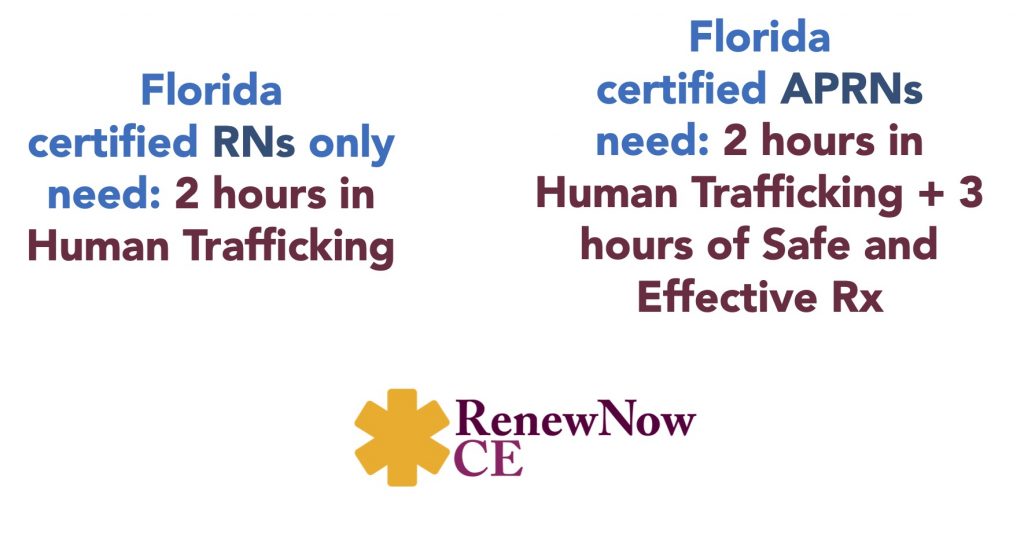
A: No. Florida certified nurses are exempt from general continuing education requirements for license renewal. However, certain mandatory courses still apply:

  • Human Trafficking Course: 2 hours (required for RNs and APRNs)
  • Safe and Effective Prescription of Controlled Substances Course: 3 hours (required for APRNs only)

To claim the exemption, nurses must report their certification through CE Broker for each renewal cycle.

Renew Now CE provides an Instant Certificate for immediate license submission.

FL Certified Nurses Are Exempt from Continuing Ed! What You Need to Know

Great news for Florida nurses! The Florida Board of Nursing (BON) has updated its continuing education (CE) requirements, and now FL certified nurses are exempt from continuing ed! If you’re a certified nurse, you can significantly reduce your required CE hours—but there are still a couple of courses you must complete.

Still Need the Required Courses? We’ve Got You Covered!

Even though FL certified nurses are exempt from continuing ed, you still need to complete the mandatory courses. We offer:

Not certified? No problem! Check out our Complete CE Package for Florida nurses:

What Is a Certified Nurse?

The Florida Board of Nursing defines a certified nurse as one who holds certification through a healthcare specialty program accredited by:

  • The National Commission for Certifying Agencies (NCCA)
  • The Accreditation Board for Specialty Nursing Certification (ABSNC)

If you meet these criteria, you qualify for the CE exemption! However, even though FL certified nurses are exempt from continuing ed, there are two CE courses still required for renewal:

  1. 2-hour Human Trafficking course (for RNs and APRNs)
  2. 3-hour Safe and Effective Prescription of Controlled Substances course (for APRNs only)

How to Apply for the CE Exemption

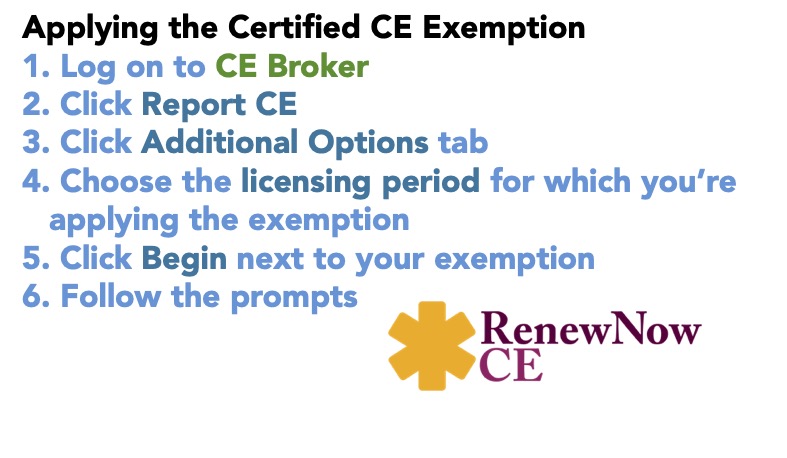
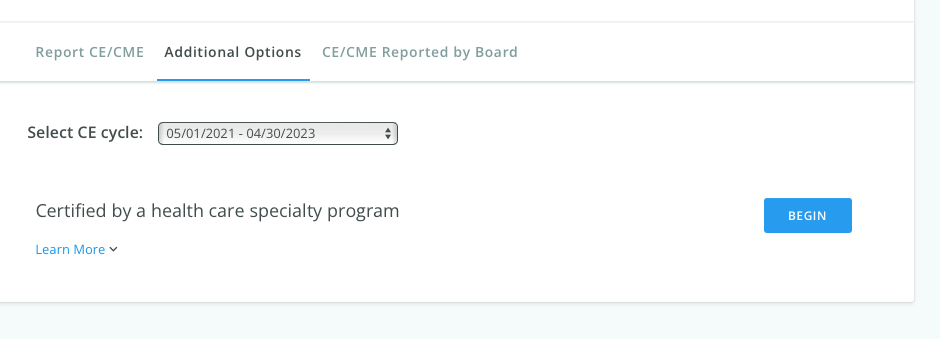
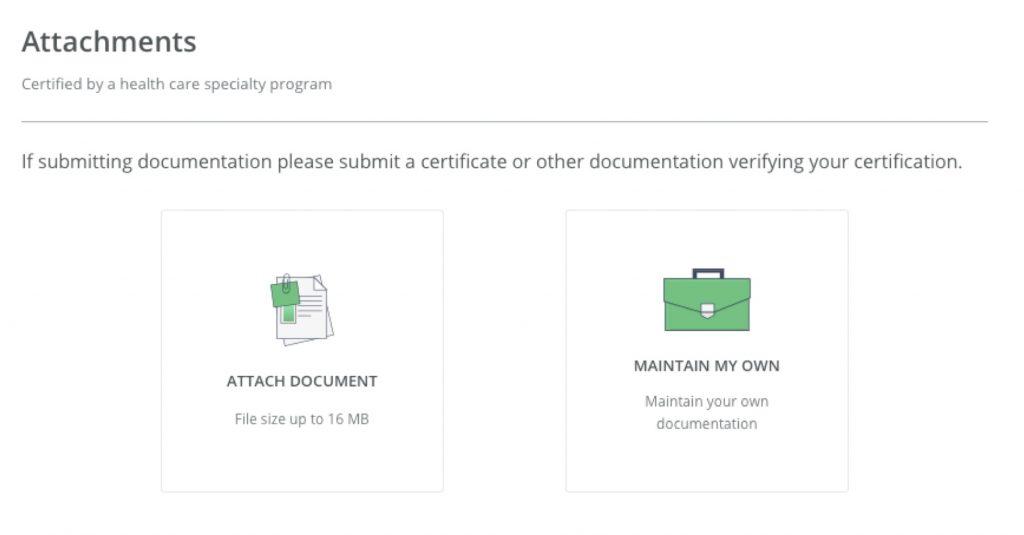
To claim your CE exemption, you must report your certification to CE Broker, the Florida Department of Health’s tracking system. This exemption must be applied for every renewal cycle, so be sure to update your status biennially.

2. SELECT REPORT CE: CHOOSE REPORT CE, THEN SELECT ADDITIONAL OPTIONS AND YOUR RENEWAL WINDOW.

3. UPLOAD DOCUMENTATION: AFTER SELECTING YOUR CYCLE, YOU WILL BE PROMPTED TO UPLOAD PROOF OR YOUR OWN DOCUMENTATION.

Why Renew Now CE is the Smart Choice for Your License Renewal Continuing Education:

  • Complete Your CE Requirements Today — No Subscriptions, No Stress
  • Trusted by 100,000+ Clinicians Nationwide: Fast, accurate, and easy — with thousands of verified 5-star reviews.
  • Buy Only What You Need: Choose a single course or a complete state bundle — no subscriptions, no upsells, no wasted hours.
  • Instant Certificate: Finish your CE today and download your certificate immediately.
  • Real Human Support: Get quick, reliable help from our U.S.-based team whenever you need it.

Stay Compliant with Florida Board of Nursing Requirements

At Renew Now CE, we’re a Florida Board of Nursing and ANCC-accredited provider of continuing education. Get your required courses today and stay compliant!

If you would like to take these courses from us on CE Broker, we offer the courses hosted on CE Broker: Provider on CE Broker Link

For more details, visit the Florida Board of Nursing renewal page here.